
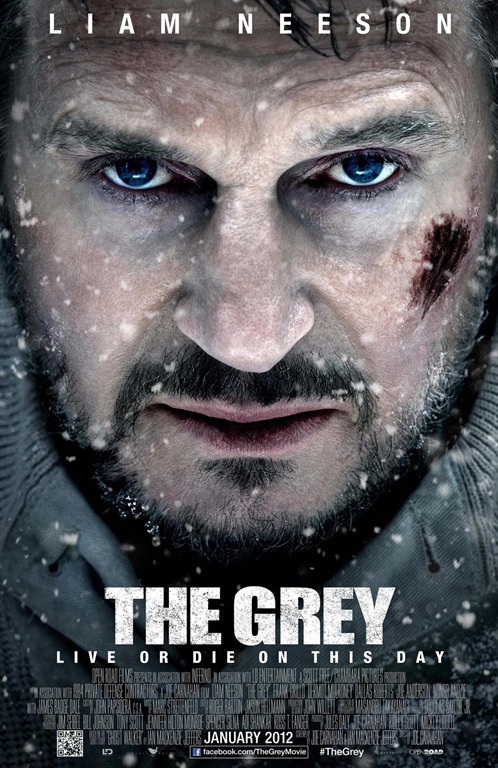
Though it’s billed as an action/suspense film, The Grey is really a philosophical musing on the nature of reality and our place in it. If we miss that, the film’s outstanding conclusion feels instead like major disappointment.
The Grey ends with Ottway (Liam Neeson) facing off against the Alpha wolf of the pack that’s hunted his party from seven men down to one. Ottway prepares himself to battle the wolf. The wolf lunges.
Cut to black. Roll credits.
Quite the letdown – the whole film feels as though it’s been building to that confrontation. And then, nothing. Such an abrupt, uncharacteristic end is a major clue to the film’s overall message:
What matters is not whether Ottway will kill the Alpha, but that he finally quits trying to escape his reality and faces it head on.
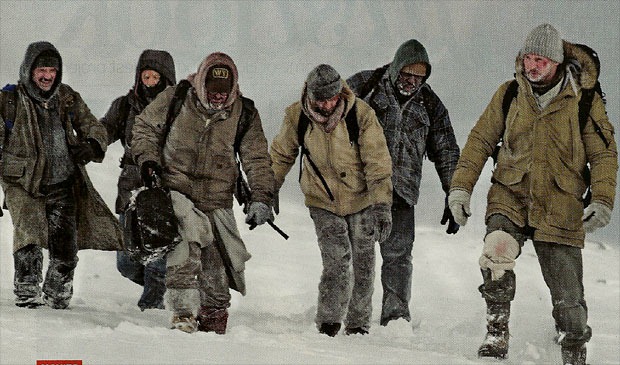 Ottway kills wolves for an oil pipeline in the Arctic. It’s hard to imagine a less hospitable place – Ottway calls it the "end of the world", full of "men unfit to live among mankind." The film opens on Ottway nearly committing suicide. This is clearly a man who’s running from something. Through flashbacks, we learn that Ottway has fled to the End of the World to escape the pain of losing his wife to illness.
The plane crash and subsequent journey become a metaphor for Ottway’s whole life, and by extension for all of us who’ve experienced loss and pain.
Our world is The Grey of the Arctic: cold and inhospitable to human life. It is Nietzsche’s Void.
 Like the men, we constantly search for some kind of escape, some rescue from the pain of our reality. In the film, the men collect the wallets of the dead to memorialize them. Before leaving the wreckage, one of the men asks for a moment to say a few words: clearly an empty gesture and meaningless in the face of the cold and the wolves, but it imposes some small measure of order on the chaos around them.
Religion can function like this too – rather than encouraging us to embrace the world as it is, to take responsibility for life in the present, we can use ritual and belief to shield us from the imperfect world.
We look for rescue not in the here-and-now, but in an Afterlife of some kind.
Though we know it’s not possible, we hope along with the men for some sort of rescue. A key moment in the film comes when Ottway, Diaz and Talget are the only three left. Diaz is injured, and rather than push forward, he collapses beside a river. Ottway and Talget implore him to go on. In perfect escapist fashion, Talget claims there might be a cabin just around the bend (of course, there’s not).
Diaz is adamant that he’s not going further, and when the three finally accept that he’s staying put, they have their first real, human moment. They take off their gloves, shake hands and offer their first names.
Their hope for escape had actually prevented the men from embracing each other as fully human. Abandoning their hope for something Out There brought them together.
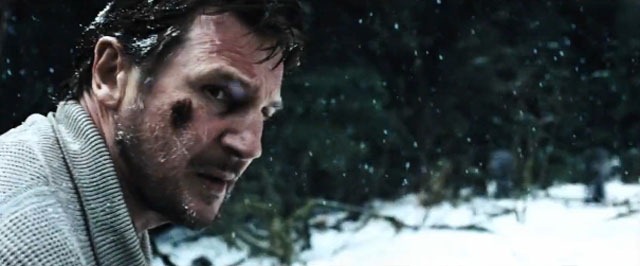 For The Grey, religion does the same for us. We look to a God who is Out There, who will come to save us. Only a few moments later, Ottway is alone, his final companion having drown. Soaking wet, freezing and alone, Ottway finally cries out angrily to God, demanding that He break into the Grey and save Ottway .
This is the moment in the film where the Cabin should appear around the bend, or the Search Party that found the plane or a random helicopter. This is the point where God is supposed to break in and save us.
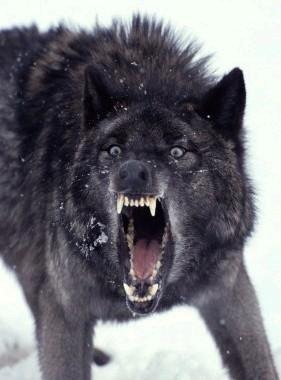 But nothing happens. Ottway is left alone with the Grey reality he started with. And when he realizes his journey has taken him straight into the wolves’ den, he too finally embraces his present.
As he prepares to battle the Alpha, Ottway calls to mind the single poem his father wrote:
Once more into the fray,
Into the last good fight I’ll ever know.
Live and die on this day,
Live and die on this day.
In the End, Ottway finally quits running, quits trying to escape his reality. Like the death of his wife, like the pain we all face, the Grey is cruel and cold. But rather than look for some other-worldly escape, The Grey says we should find meaning in the present moment. That until we accept that no help is coming, that The Grey of life is all we can expect, we’ll miss the beauty and meaning that are right in front of us.
Instead of trying to flee from the Grey, Ottway fights it. Live and die on this day.
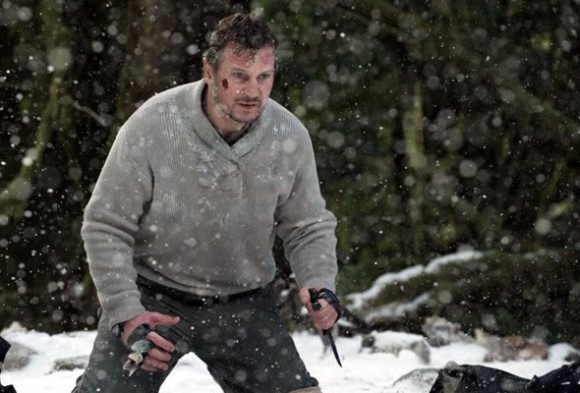 That’s why the film doesn’t show Ottway’s final battle with the Alpha. The outcome is predetermined – he is going to die whether he kills the Alpha or not. Death comes for all of us. What matters is how we face pain and death: either running from them or embracing them as part of what it means to be human. That’s what Ottway realizes beside the river, and what he finally acknowledges fully in the wolves’ den.
Ottway embraces his death. He quits running. That‘s the victory of the film.
The film embodies many of the same themes Peter Rollins outlines in his book Insurrection: God is not Out There, a deus ex machina who rescues us from reality. That we must find meaning and significance in our present by embracing it rather than always looking for a way out.
While I don’t agree that the World is essentially a cold, inhospitable place, the philosophy in The Grey is a helpful corrective to much of the Pop Christian Theology that promotes escapism and disregard for the created world. We should always be doing more to combat pain and Death in our present, not just waiting till "I’ll Fly Away".

9 replies on “Why “The Grey” Ended Like it Did”
Okay, but …the film’s trailers SHOWED him fighting the Alpha. There was more of the climactic scene in the trailer than there was in the actual movie. I can agree with your whole premise–it makes sense. But it doesn’t change the fact that I feel like I wad lied to. Couple that with the scene after the credits (did you see it?), and it has me very disappointed. I didn’t expect him to live, for the very reasons you mentioned, but I had hoped they’d at least show the part I was paying to see.
That’s really interesting, Kevin. I didn’t think about the trailer. I’m really curious about that editorial decision. I know movies often show stuff in trailers that doesn’t make the film’s final cut, but in this case, it’s a huge moment in the film.
Love it. It reminds me of the primary theme in the Conan stories of Barbarism vs. Civilization.
Ok… I’m just now reading your review. I have not yet seen this movie. I’ll probably wait until DVD at this point, just because my movie-going time is so limited these days… so precious, even. **types the word ‘precious’ with Gollum-like tones**
So I can’t speak to the philisophical intent of the movie, but I think this was one of the finest reviews of a movie I’ve ever read. I mean it, man, you nailed it on this one. Great writing, sir!
BTW, did you see the TV series LOST? If so, have you ever written about it? I have to confess that I didn’t watch it as it came on TV. Then, last year, my wife and I signed up for a 14 day Netflix free trial and saw that the full series was available. So we started it. Exactly 29 days later we had watched the entire series of LOST. It was so fun to ingest it in such a short period of time. Anyway, so we’re still all hot and heavy into discussing it, but everyone I know has moved on, with the exception of my pastor who is always game for a great LOST discussion. Anyway, I’d love to hear your thoughts on the show if you’ve ever written about them. If you haven’t, I’d like to request that you do.
Thanks Mike 🙂 You should definitely see “The Grey” – it’s outstanding!
I’ve not made it through LOST yet (I know, I know). I’m about 1/2 way through Season 2 and need to pick it back up. Once I’ve finished, we’ll have to compare notes 😀
I like the movie but I am really disapointed and suprised that they ignored the fighting scene at the end it would’ve gotten a perfect score if they didn’t ignor it.
I know what you mean – I felt that same absence. But I think that if the film had included the final sequence, I would’ve been less likely to analyze it. Because I felt that lack, I had to explore it more.
In general though, wolf fight in a movie = win for me!
After the credits it does show the outcome of the fight.
Very late in the game here but I love your take. I am 26 years old and work in law enforcement and have had to deal with death at a young age with multiple family members. I feel we all handle death differently but I feel this movie shows that its ok to view it differently but if you embrace it than no matter what the views are you will always be at piece. There’s a lot of beauty in this world and a lot of tragedy too. If you embrace and accept them both you enjoy the beauties so much more. You summed it up great and thank you for that because this helped me get a clearer understanding of the message to this film.