
To be is to be perceived. The only way to know thyself is in the eyes of the Other.
— Sonmi-451
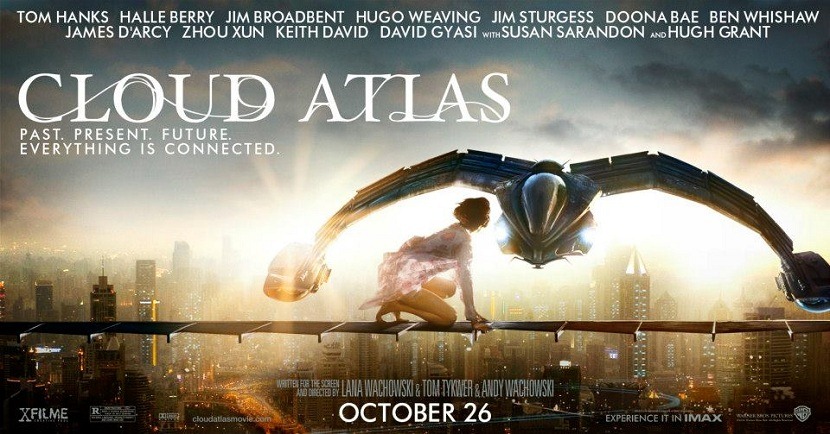 Cloud Atlas is the ambitious new film from the Wachowski Siblings (The Matrix Trilogy) and Tom Tykwer (Run Lola Run). Based on the novel by David Mitchell, it features six stories set from an 1849 slaving ship to far-future, post-apocalyptic Hawaii. The star-studded cast all played roles in each of the storylines, sometimes in such good makeup they were unrecognizable.
The film’s so huge, it’s hard to condense into a review (It was hard to condense into a film!). Suffice to say it’s worth seeing, and you’ll want to see it more than once. After the jump, we’ll dive into the film’s key themes.
The film ends with a shooting star flashing across the sky, calling to mind the shooting-star-shaped birthmark we saw over and over on the film’s central characters. We’re meant to understand that each human life is just that: an all-to-brief flash in an endless ocean of time.
Though each human life seems small and insignificant, Cloud Atlas demonstrates that our actions have meaning. Our choices ripple throughout time.

greed and love.
Each story features the tension between the “Way Things Are” and the “Way Things Could Be”. The “Way Things Are” always involves oppressing some group so some other group can maintain power.
In 1849, blacks are held to be naturally inferior to whites. Slavery is the natural order. In the late 1920s, we get hints of Nazism and the oppression of the Jewish people. In the 1970s, it was the corporations destroying the environment and in 2012, middle-aged people sent their aging parents to nursing homes. 2144 shows us a dystopian future in which we grow slaves replicants to serve the all-mighty Consumers. And in the post-apocalyptic world, Valleymen hide from the cannibalistic Kona, who slaughter and consume them without mercy.
There is a natural order to this world. And for those who try to end it does not end well. — Haskell Moore/Boardman Mephi

the ‘natural order’.
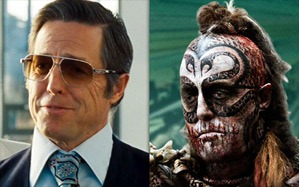
In every time, some profit from power (Hugh Grant). Some, because they see it as the ‘natural order’, work to uphold the Way Things Are (Hugo Weaving). Everyone else is caught in between, wondering if the world can ever be other than the Way Things Are.
In 1849, Dr. Henry Goose digs up teeth on a beach, teeth that he says were buried by cannibals. From Cannibalism to slavery. From Slavery to Holocaust. From Holocaust to shutting away the old and broken. From Nursing Homes to Soylent-Green Replicant Recycling facilities. From the facilities back to Cannibalism.
In every story, Cloud Atlas highlights two forces at work in the world. One is greed. One is love. One dehumanizes, profits at the expense of the Other, and brings death. The other humanizes, embraces the Other and brings life. Characters in each story are torn between these two forces.
Will we join against the forces that seek to dehumanize us? Or will we continue to ignore those we’ve been told are invisible?
You have to do whatever you can’t not do. — Louisa Ray
Cloud Atlas demonstrates that we only overcome our prejudices by engaging the Other.
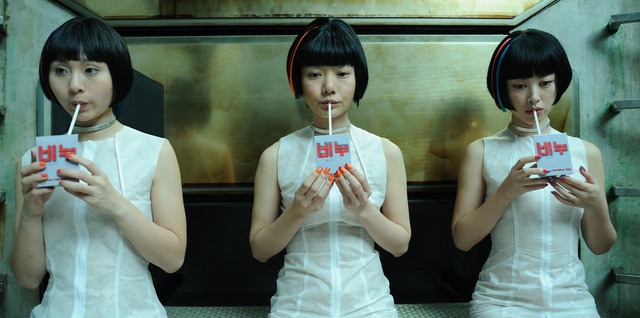
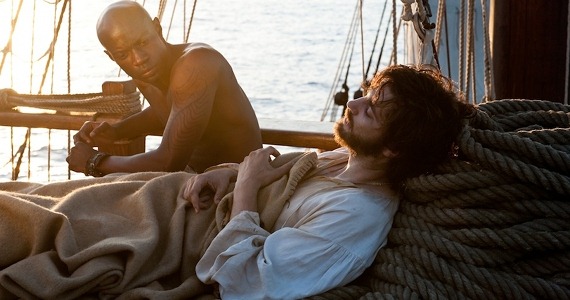
It’s not until those who have power are forced to confront the humanity of those they oppress that they begin to change. So Adam Ewing discovers a friend and savior in the stow-away slave Autua. Meronym (Halle Berry) doesn’t value the lives of the Valleymen until she befriends Zachry (Tom Hanks). And the Archivist sees no reason to question the system until he interviews Sonmi-451.
That ship must be destroyed. The systems that built it must be torn down. Whether born in a womb or made, We are all pure blood. We must fight and even die to reach everyone the truth.
— Sonmi-451, upon seeing the ship that “recycles” replicants
Once we’ve overcome our prejudices, we can join the fight to humanize the Other. We can join the struggle against the systems of oppression we find in our own time.
Cloud Atlas presents knowledge as the vehicle towards freedom, both for the oppressed and the oppressor. The more we learn, the more we see what is possible. The more we see the common threads that unite us beyond anything that might try to divide us.
Knowledge is a mirror. I was finally able to see what I was. And what I could be. — Sonmi-451
All it takes is a vision of a better world. A better, more just world can’t be unseen, so its advent can be delayed, but not stopped.
I’ve seen too much of the world. I’m no good slave. — Autua
oppressed and oppressor free.
Though our lives may be the briefest flash, we can use them to make a difference. We can imagine a better world, then take the first, small steps toward it. Ultimately, this may be our greatest gift to the world. It’s certainly Cloud Atlas‘ strongest message.
Our lives are not our own. From womb to tomb we are bound to others. Past and present. And by each crime and every kindness we birth our future. — Sonmi-451

10 replies on “What is Cloud Atlas About?”
This is the most compelling and beautiful explanation/ interpretation of Cloud Atlas. Thank you.
Thanks Margo! I take it you enjoyed the film?
I really want to write one more piece about how I feel the film has a couple of themes that don’t work well together, too. Hopefully next week…
I saw the film on dvd and really enjoyed the imagery and
didn’t mind the jumping between the numerous stroylines. However, I had no idea
what was going on, and thoroughly confused, I gave up a third of the way
through. I wanted to give it another go and this review has certainly helped me
get to grips with the storylines and how they are similar, though set in different
times. Thanks for helping to understand the film!
Very good review. I like how you underline the themes, and I agree with your reading. I and my girlfriend really appreciate this film and we have talked about a long, trying to understand and find out new elements.
My favourite story? Maybe the Sonmi-451 one, but also the love story of the 1920s is so touching.
So I finally got to watch this movie. Ummm… After starting it too late the other night and then trying to start again I was just about ready to give up on it. That is SO rare for me. In a last ditch effort to find out how in the world I was missing every single thing in this flick I came here. Now that I understand what the movie is trying to do, I guess I would have to give it another viewing to be fair. I just don’t know that I want to.
But I also want to support Hollywood’s rare attempt to try something different. I just wish they would somehow have explained it even a little bit. Sometimes character goals over multiple lifetimes are clear, like Hugo Weaving’s roles. But the others are just, I don’t know, I can’t even articulate what’s so puzzling about this movie. It just doesn’t make sense.
Completed viewing it. Yeah, I’m just too Westernized I guess. At least it did well in China, so they didn’t lost money. I liked the 2012 timeline with the old folks the most. Those were really the only characters I cared about which is why I wasn’t so engaged in the other story lines. Just didn’t care about those characters at all.
I’ll say I watched it three times and liked it more each time. I came to care about the archetypes as they moved through each timeline.
Google the characters each actor played. Pretty cool.
I was definitely surprised to find out some of the actors who were wearing the makeup.
I think I was tracking with part of the movie, recognizing the consistency in certain characters. As you say here: “In every time, some profit from power (Hugh Grant). Some, because they see it as the ‘natural order’, work to uphold the Way Things Are (Hugo Weaving). Everyone else is caught in between, wondering if the world can ever be other than the Way Things Are.”
But then I see Tom Hanks portraying people who are all over the place morally and it made me think I’m not supposed to be seeing these archetypes. So then I tried to figure out how the personal letters were the key to understanding the story or maybe the music composition.
I would enjoy it a little more not that I’m in on it some, but I doubt many people will give it a second chance.
According to the filmmakers, the whole film is about Hanks’ archetype/soul’s progress toward “enlightenment”/salvation/goodness thanks to interactions w/ Halle Berry’s archetype/soul.