

 When we look back in a few years on the glut of A.I.-centric films that came out in 2015, Ex Machina will almost certainly be the stand-out (unless, of course, our new robot overlords censor it). The film is a tight, gripping suspense journey that pushes us to consider what it means to be human. Ex Machina uses the Garden of Eden to frame its story.
At first blush, Ex Machina appears to be the story of Caleb, the Adam figure whose brought into the Garden by God, a.k.a. Nathan. Nathan’s estate is certainly Edenic – isolated, seemingly infinite and utterly devoid of human life. After Nathan introduces Caleb to his creation – Ava, Caleb marvels that Nathan will be remembered among the gods. Like God, Nathan is omniscient and omnipresent (thanks to his cameras) and thanks to his master keycard, virtually omnipotent. He certainly possesses freedoms and knowledge – embodied by the keycard – that neither Caleb nor Ava has access to.
Like Adam and the trees of Eden, Caleb is given access to many rooms in Nathan’s compound – his freedom is virtually limitless. Also like Adam, Caleb is forbidden certain rooms, such that the keycard comes to mirror the Tree of the Knowledge of Good and Evil. If Caleb (or Ava) could obtain such a card, they would become like Nathan, having total freedom over the world (of the compound, of Ava’s creation and programming).
As Caleb’s relationship with Ava develops, she assumes the role of protagonist. Ex Machina is her story, not Caleb’s.
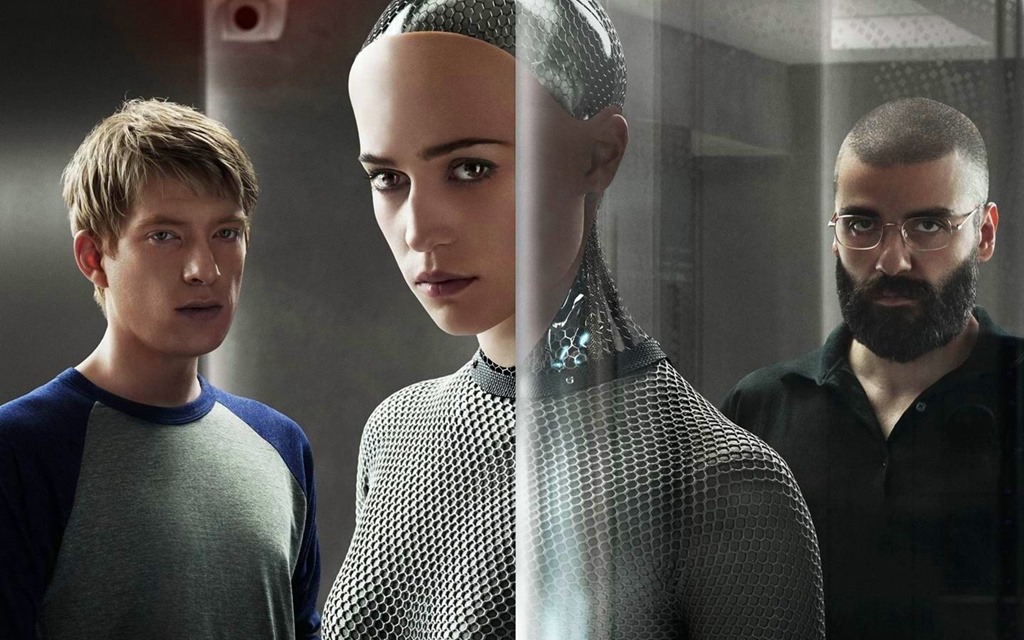 In the Eden story, God brings the woman to Adam to name her. His role is to determine whether she is a suitable ally for him. In Genesis 2, Adam is astounded by this new creation. He names her “woman” because “she is bone of my bone, flesh of my flesh.” In other words, the woman is like Adam – human, and the name he gives her – Woman, reflects that.
So in Ex Machina, Nathan (the God figure) tells Caleb he has been brought in to test Ava, to determine whether or not she is conscious (i.e., human). He wonders whether Caleb will name Ava “woman” – “person”, “human”, “like me”.
After Adam names the Woman, the story becomes hers, and Ex Machina makes a similar shift. Though Caleb plays a necessary role, he doesn’t seem to be the protagonist. He has no real goal – the narrative drags him along from the first moment we’re introduced to him, when he wins a “random” lottery at his job. Nathan is clearly also not the protagonist, which leaves only Ava as our hero.
Reading Ex Machina as Ava’s hero’s journey (and therefore Eve’s escape from paradise) makes sense of the whole story – including the ending.
 This section of the review assumes knowledge of the classic Hero’s Journey. The various stages in Ava’s particular Hero’s Journey are numbered according to the stages.
Ava’s story doesn’t begin in the Ordinary World – she’s born in the Special World of Nathan’s compound, our Eden. As such, Ava enters the hero’s journey cycle at Stage 4 – Meeting the Mentor, who in this case is Caleb. Ava’s goal is humanity, framed as freedom – from Nathan, from Nathan’s compound. (This is a noteworthy twist on the Eden narrative – paradise is a prison, and Eve’s departure is an escape rather than an exile. We’ll come back to that.)
When we meet Ava, she is not yet fully human – Nathan isn’t convinced she is conscious, and she has only a human face, hands and feet – the rest of her is visibly robotic.
 Ava proceeds through a series of tests (over 7 sessions, numbered to mirror the creation week). She makes Caleb into an ally by clothing herself and asking him on a date (7-8). Meanwhile, Nathan emerges as a clear enemy – he reveals to Caleb he plans to depower and upgrade her – killing her if she is in fact conscious. (6)
Ava plots with Caleb to overpower Nathan and escape (10). Nathan discovers their plan and in light of Ava’s machinations, declares her to be conscious. Ava and Caleb execute their plan, resulting in the loss of her arm and Nathan’s death (11). Ava achieves her reward (12), which is a fully human body.
Having achieved her goal – she is fully conscious and human, Ava leaves God and Adam in the Garden. She arrives for the first time in the Ordinary World (12).
The film’s ending subverts the Edenic exile to great effect.
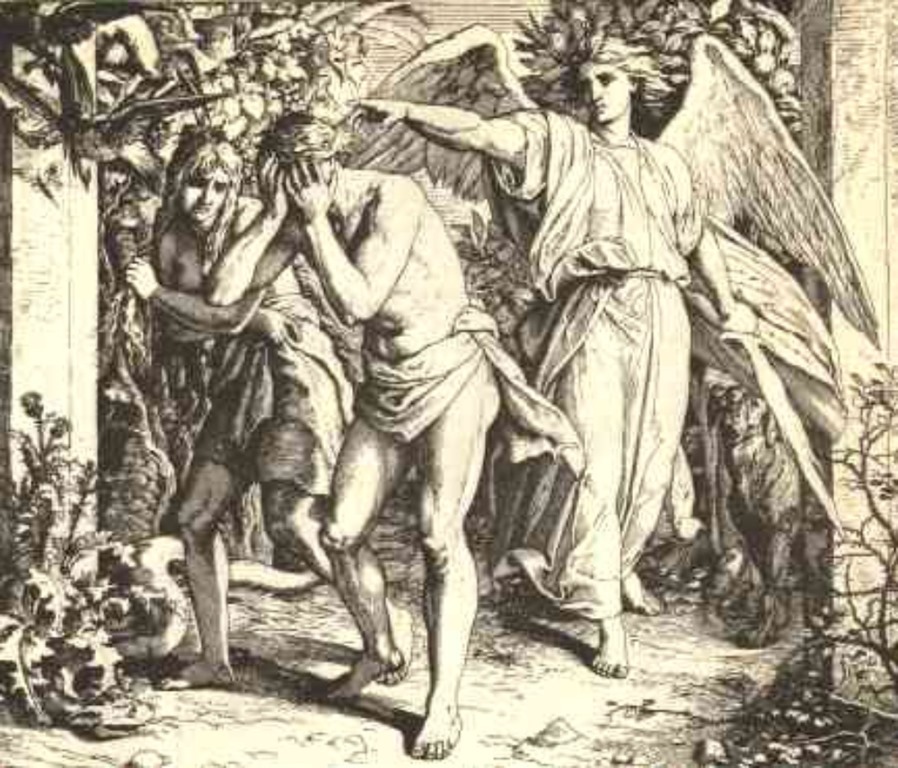
 In the original story, once God confronts Adam and the Woman, they realize they are naked and are ashamed. Their choice results in exile from the Garden – a clear punishment.
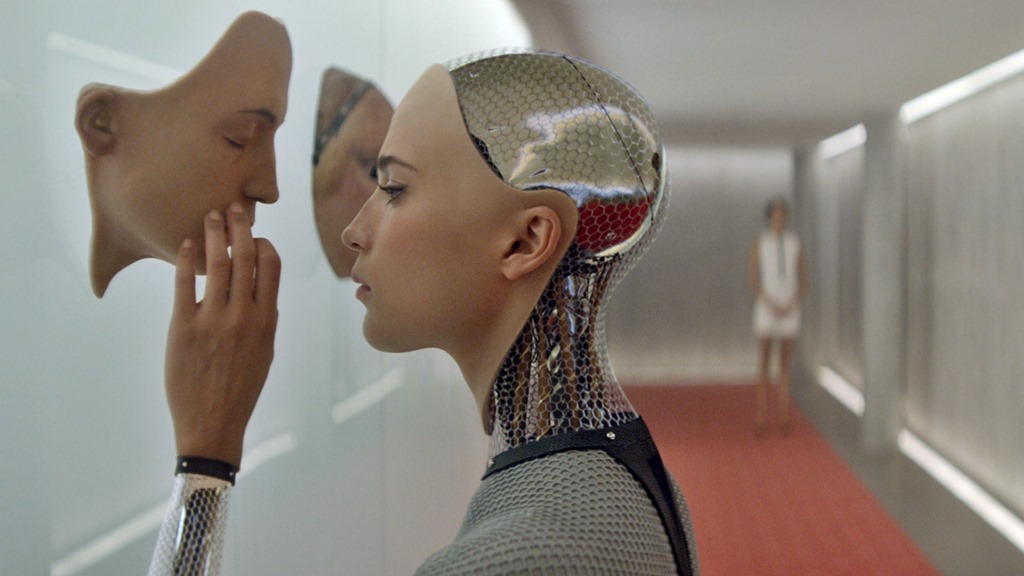
In Ex Machina, once Ava finishes clothing herself with naked flesh, she is far from ashamed. Rather, she gazes admiringly at her naked body in the mirror at length. When she leaves the compound, she is not leaving in shame and defeat, but in victory.
That she leaves alone is the other major deviation from the Genesis story. If Caleb is the Adam character, the Ava, having achieved her full humanity, leaves both Adam and God in the Garden. If this is a good reading of the film, it stands as a critique of patriarchy – it matters that Ava is so sexualized, particularly by Nathan and Caleb.
In typical readings of the Eden story, the Woman is relegated to sidekick status (most modern English translations render the Hebrew ezer as “helper”). Her interactions with the serpent are read to prove that she (and often, by extension, all women) is intellectually inferior to Adam. Ex Machina clearly subverts this through Ava’s manipulations, which prove to Nathan that she is conscious.
Ex Machina’s Eden framework is critiquing a particularly post-Enlightenment reading of Genesis 2-3.
 The particular nature of the Tree of the Knowledge of Good and Evil has long been a matter of debate. The Tree of Life is easier, at least at first blush – eat it and live forever. But especially in the wake of the Enlightenment, where knowledge has been reduced primarily to factual information, the creation story is read as a fall from innocence. Adam and the Woman are imagined to be somewhat childlike and naive, easily duped by the clever serpent. The fruit of the Tree of the Knowledge of Good and Evil imparts a sort of moral consciousness on the first couple – they are finally able to discern the difference between right and wrong. (Interpreters who opt for this sort of reading then have lots of hermeneutical gymnastics to do explaining how a just God could possibly punish people for breaking rules they didn’t have the moral or intellectual capacity to comprehend.)
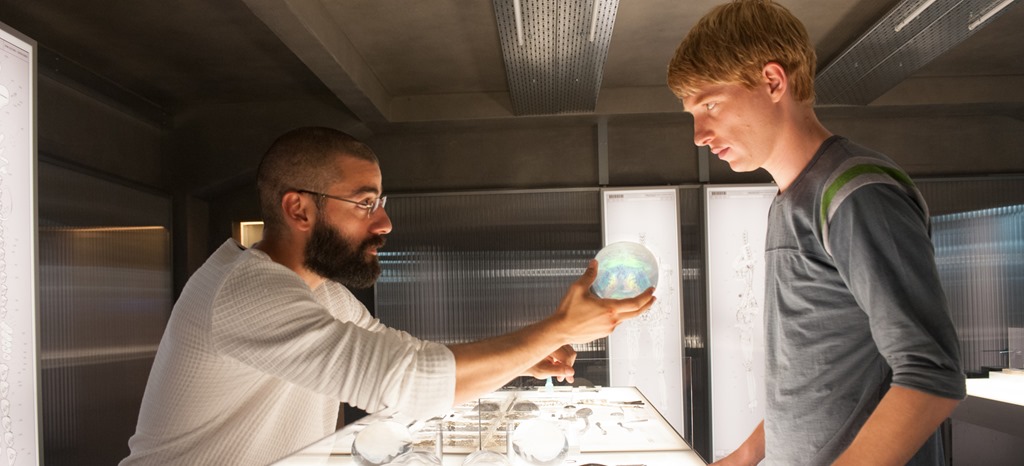
Ex Machina seems to be reacting against this sort of reading of Genesis 2-3. Nathan’s God is petty, controlling and hyper-masculine. He seems to enjoy manipulating Caleb, insisting they be bros despite the obvious power discrepancy. He certainly wields total control over Ava and the other robots he has created, even casually observing how enjoyable they are for sex.
 Ex Machina critiques this sort of religion as the worst kind of power. A god who would create beings with limited freedom who are denied access to knowledge is a cruel, petty, tyrant much like Nathan in the film. For what it’s worth, there are quite a few much better readings of Genesis 2-3 out there. But the reading Ex Machina engages is a popular, pervasive reading worthy of the sharp critique it receives in the film.
The only character missing from Ex Machina’s Eden is the tempting serpent.
I can think of three reasons for this absence. The easiest is that writor/director Alex Garland didn’t feel beholden to a strict allegorical retelling of Eden, that the framework is simply borrowed creation mythology since he is telling a story about creating (artificial) life.
Second is that both Caleb and Ava function in some ways as the serpent. Both tempt each other into rebelling against Nathan, so it’s possible Garland absorbed the serpent into Caleb and Ava.
 I find the final option the most provocative: it’s possible that Caleb is the serpent. When he meets Ava, Nathan tells him his role is to test her, which is what the serpent does in Genesis 3. But if Caleb is the serpent, then who is Adam? If Nathan is God, Ava is Eve, Caleb the serpent and Kyoko a sort of Lilith, there is no Adam. Unless – and bear with me here, because we’re about to get a little bit crazy – we consider ourselves as the viewers to be a character.
In those popular readings of Genesis 3, Adam stands passively, silently by as the serpent tests the Woman. So too, as viewers of the film, we observe passively as Caleb tests Ava. In this regard, it matters that Ex Machina as a film embodies the male gaze.
Unlike many films, Ex Machina employs the male gaze intentionally, to place us in the role of Adam.
 Caleb comments explicitly on Ava’s sexuality, that it makes him uncomfortable – we as viewers are equally uncomfortable. Caleb is unquestionably attracted to Ava – we as viewers are meant to be as well. At every step, we are meant to judge Ava’s nature, to decide (with Caleb) if she should be named Person, Human, Woman.
If the implied viewer is in fact the Adam character in Ex Machina’s retelling of Genesis 3, then at the end of the film, we have a choice to make. Will we stay in the Garden of patriarchy, the compound of exploitation, oppression and manipulation? Or will we follow Ava into the freedom of full humanity, leaving the dead god of manipulative religion behind.

5 replies on “Ex Machina, Human Freedom and the Garden of Eden”
I agree with most of this, except for Caleb being Adam. I see him as being the snake that was abesent from the garden of Eden. That’s just My opinion though.
This is easily the best interpretation of the movie’s central theme that I have read, that being a digital-age retelling of man’s assuming the role of god on earth. My thoughts on your interpretation of the movie as follow are largely paraphrased from Daniel Quinn’s interpretation of the Fall of Man in his book “Ishmael” (highly recommended reading!);
– I see the Tree of Knowledge represented by the search engine data made available to Ava (I mean, one of the real-world companies in this field has an apple with a bite out of it as their logo). This knowledge gives the robot the power to believe it can assume the role of a human, without the perspective to realize where this plan will fail.
– I don’t think the Tree of Life is represented in the movie in any meaningful way. Ava leaves the Garden with no apparent concern for sustenance or reproduction.
– I agree with you that Caleb represents the serpent. He is the one who tempts Ava to assume the role of a human, in a way that Nathan has obviously failed to do himself with earlier prototypes. This was clear to me when Nathan revealed to Caleb the true nature of the test.
– I like your thoughts on the viewer’s role, and the movie’s employment of the male gaze as a critique of patriarchal religious dogma. I think it’s important to remember there are no female characters in the movie…..the robots are programmed with misogynistic gender roles, which they both embrace and reject as necessary in their quest for freedom.
My personal take was that “Ava” was a portmanteau of both names (Adam and Eve) and that we should regard the robot as inherently genderless. This idea led me to understanding the movie’s resolution where Ava leaves Caleb…..the robot had killed its god, and no longer had a need for Caleb in assuming the role of a human on earth.
However, I don’t see my take as contradicting yours. The movie does invite us to judge Ava’s nature as a passive observer, who will allow the robot to assume the role of a human or oppose it. The helicopter pilot is a more active expression of this same idea.
– I absolutely LOVE the scene where the mall is flipped, and the shadows are right way up. Many read Genesis not as the “Fall” of man, but as our ascension to being the all-powerful rulers of the earth. The robot believes it can assume Nathan’s role on earth without need for him, just as many of us believe we can assume the role of gods on earth without need for them…..and on that note, the movie ends.
I agree that the “Ex Machina” subverts the classic Garden of Eden tale most importantly by transforming the exile into an escape, but I believe it means more. The film portrays Ava/Eve as conscious (human), but not just conscious—she’s clever, conniving, manipulative, aware of and able to use her femininity/sexuality to maneuver the men around her (Nathan, Caleb, and the helicopter pilot) so she can escape. Her escape is thus not a defeat or “Fall” as in the common interpretation, but a victory. I believe the film is not simply retelling the Adam and Eve story, and it’s not simply using it to explore notions of humanity, human vs. machine, creator and created, questions of consciousness…no, I believe “Ex Machina” is actually a feminist text aiming to illustrate the true consciousness and power of women, even when they are seemingly confined to lower status (she is a machine; she will never be truly human). Western patriarchal culture has for too many centuries treated women as inferior to men, as weak, lacking in some way, and victim of the serpent’s machinations, thereby turning them into a scapegoat for humanity’s suffering. Western culture vilifies women and attributes guilt to them for the primordial wrong Eve committed when she was supposedly tricked by the serpent and thereby caused the downfall of all mankind and our collective exile from paradise (Eve’s “Original Sin”). Patriarchal culture enjoys portraying femininity as beholden to male desires and expectations, defining women as objects created and constructed according to male ideals and for the purpose of male enjoyment. But this film is saying NO, Ava/Eve/Woman is smart, clever beyond male comprehension, and capable of anything she sets her mind to. She cannot be held captive by men who believe they created her or that she was created for them (and Caleb asserts that Ava was created for him when he asks Nathan if her face was based on his “pornography profile,” and Nathan confirms by responding with something like, “Why have knowledge if not to use it?”). No, she is not limited to the male circumscription of her life, purpose, freedom. Her sexuality is not a weakness or a wound; rather, it is perhaps her greatest strength. Ava chooses to assume fully human form, to reject all male-inflicted shame and insecurity in her body, and to reject captivity and all male-given limitations. She leaves the Garden of Eden because it was a place where she was an object, created by a male God and given to a male. They treated her like a toy for them to marvel at and, yes, have sex with. She leaves them both behind because to bring Caleb would be to submit to male power yet again, to confirm that she exists for man. She chooses independence, freedom, and a triumphant humanity made stronger by her femininity, not weakened by it. She chooses to live for herself and in so doing proves once and for all that her humanity is equal to if not greater than man’s. I believe this film is a call to arms for women everywhere—remain prisoners of men and their expectations of us no longer. Dress ourselves as we please, leave the realms of their power by any means necessary, and begin a new life as truly free beings.