
I understand why the hippo did it. — Max
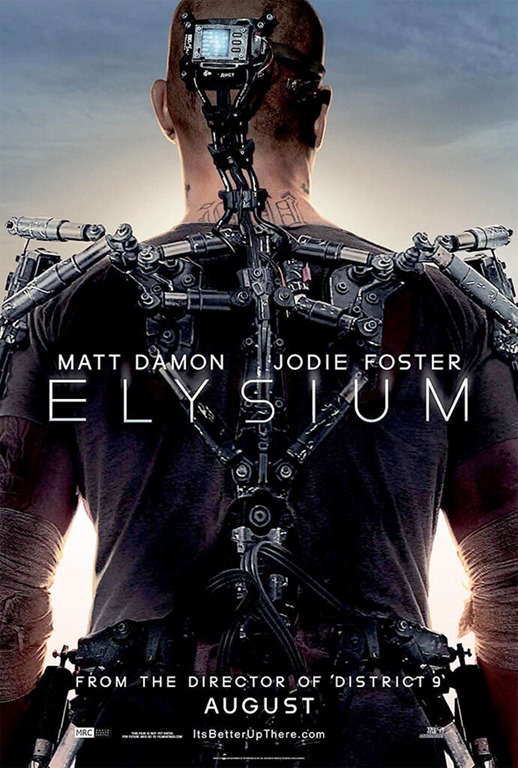 Elysium is the last of the 2013 summer blockbusters, and this year saved the best for last. Forget Star Trek Into Darkness or Man of Steel or even Pacific Rim (though it’s a close second). With his second film Elysium, director Neil Blomkamp (of District 9 fame) gives us a tightly-plotted, well-acted and thrillingly-executed dystopian thriller that leaves us with plenty to chew on. It’s also one of the only films this summer that’s not a sequel or reboot (Pacific Rim, The Heat and The Conjuring are among the few others, and they’re all spectacular).
Blomkamp’s District 9 was a not-so-subtle reflection on apartheid (Blomkamp’s a native South African), and even the trailer for Elysium reveals this film confronts immigration just as directly. Though many complain Elysium is too heavy-handed, I disagree. My favorite sci-fi is always social commentary with a thin layer of glossy tech (::cough:: Star Trek). And given the state of our American conversation on Immigration – and the continued actions of the states of Arizona and Texas, we could clearly handle a bit less subtlety when it comes to immigrants.
But as the film’s title implies, Blomkamp isn’t just talking about immigration. Elysium wants to say something about religion, too.
Elysium is a space station where Earth’s wealthiest elite live. Elysium takes its name from the Elysium Fields, the ancient Greek equivalent of Heaven, reserved for the children of gods and heroes of legend. And indeed, Elysium is Heaven. No war, no crime, no poverty. No illness and no death. On Elysium, humanity has finally achieved the dream we had in Genesis 11: we built a tower to the sky and became gods.
Elysium is a latter-day Tower of Babel, an image of human hubris.
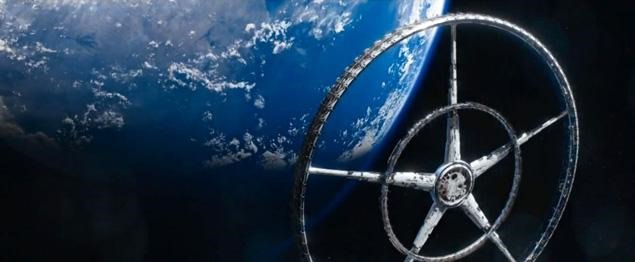
That ought to make the film’s parallels to contemporary America all the more disturbing. From our (American) first world perspective, a space station for Earth’s elite seems farcical. But anyone who’s ever visited the two-thirds world knows that’s exactly how many of the global poor view our country. We’re a land of impossible luxury and wealth, as distant, unobtainable and impenetrable as a futuristic space station.

Even more, Elysium‘s picture of religion out to disturb we religious people who live in the first world. If Elysium is a manufacture Heaven, the droid-infrastructure becomes a stand-in for religion. In the film, droids manage everything, from policing and private security to parole monitoring. The droids are responsible to keep the citizens of Elysium safe, ignorant and happy. They keep the rest of humanity out of sight and out of mind.
Religion often functions the same way: our churches are structured to cater to the insiders, to the ‘religious’ folk, to the people who are already going ‘up there’. Our preaching, our hospitality (or lack thereof), our language and our liturgies all conspire to keep bad people out and good people in (good being like us and bad being different, of course).
We too often use religion as a barrier between God and those we deem unworthy.

Evangelicalism does it today, as did the Pharisees of Jesus’ time. And this is the real brilliance of Blomkamp’s film: Max is a Christ-figure who tears down heaven so everyone can reach “god”. Whereas Jesus left heaven and became human, Max becomes less-than-human, by donning the exoskeleton, so he can enter heaven. Whereas Jesus willingly surrendered his life for humanity, Max is at first selfish: he only wants to be healed himself.
Ultimately, Max becomes a Jesus-figure when he chooses to die wholly for the good of those he loves. There’s nothing in it for him, no advantage, no possibility of rescue. He finds himself not in reaching the beauty of Heaven Elysium, but in embracing Earth Frey.
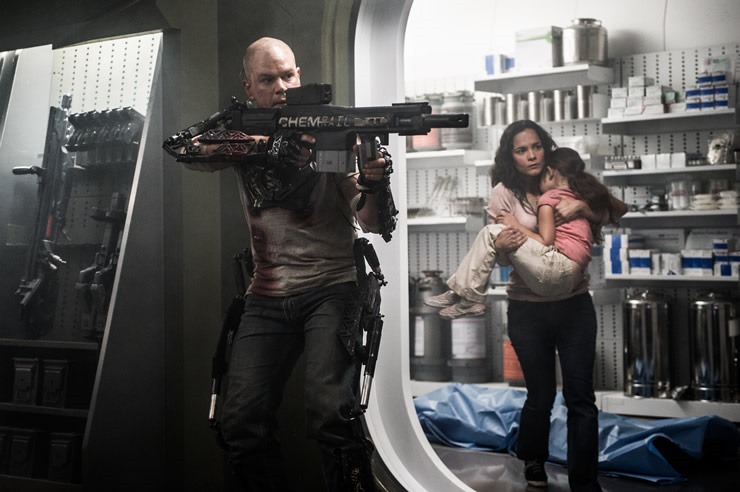
Max finally learns what counts as beautiful religion, a lesson a nun taught him as a child: as beautiful as we think Heaven looks, true beauty is found here, among God’s creations.
It’s worth noting Max isn’t a 1-to-1 Jesus-figure. Since there’s no explicit God figure, we also don’t get any incarnation story. Max isn’t a lost child of Elysium raised in the slums of Los Angeles or anything. He’s just an ordinary guy who dreams of Heaven Elysium. There’s also no resurrection: Max simply dies to open heaven up to the rest of us. But the story works great, and after the heavy-handed Jesus-imagery in Man of Steel, Max’s subtler messiah is a breath of fresh air.
Elysium warns how easily religion can become a tool of Empire.
Empires always set themselves up as gods. Empires can only enjoy extravagant wealth by denying the humanity of everyone else. The violence of Death is always the final enemy, and the final weapon of Empire. These are true in Elysium because they’re always true. They’re human truths.
And as Max demonstrates, only death can shatter the Empire’s false heaven, unblock religion and affirm the full humanity of every person. Once Max has sacrificed himself, Elysium’s religious droid infrastructure finally begins to serve all humanity, not just the wealthy 1%. Heaven comes down to Earth and all humanity is finally rescued. Pretty cool way to end a story!

6 replies on “Elysium’s Upside-Down Jesus”
JR – @stacydazet and I loved the film – so many great themes throughout. Thanks for the blog post.
Nice thoughts, but sounds like he got his inspiration from the Astro Boy cartoons.
Also, you may want to bury the hatchet with your distain for evangelicalism. To use such a broad category of people with such specific charges is a straw man argument. to focus on more specific groups would cause less of a villian-ing a whole group without proof.
Back to the movie notes. I have not seen it, but what you describe sounds to me more like a works theology. An everyday men can force/fight his way into heaven.
–mark west. ( login crashed on me so had to go anonymous)
Astro Boy – I’m amazed by the creator’s desire to minister to the kids who lost their parents in WWII, especially those who were orphaned by the nuking of Hiroshima and Nagasaki. Astro Boy fought for “peace” not “justice”. “Astro Boy was a heartening comic about a purely innocent boy robot hero who wants not to punish bad guys but to simply stop them from doing evil and hopefully turn them to good.”
Not sure if there is a disdain, but a burning desire to improve, to fix modern expressions of Evangelicalism.
I have disdain for what Evangelicalism has become. I’ve tried to convince JR to have disdain for it too – he won’t take the bait. 🙁
I wouldn’t say I have a “hatchet” to bury with Evangelicalism. After all, I’m a pastor in an Evangelical church. And there’s plenty of research to back up at least the statements I’ve made in this article. Your critique seems to be more against generalizing in general. Of course any time we talk about groups, the statements we make don’t apply to everyone in the group.
I’d encourage you to see the film. There’s no “works salvation” because there’s no God figure. Humans built heaven and humans keep other humans out. Max can’t “work” his way there. He has to break in.
Yea I probability need to see it before I make assumptions on a film.
“It’s worth noting Max isn’t a 1-to-1 Jesus-figure.” It’s also worth noting that that is the premise of the teaching of Christianity. An “average guy”, the meek inheriting the earth, the power of love that empowers the weak. IMO Max was meant to be an image of walking in His steps, not Him. If every revolution depended on just the central figure nothing would revolve. Also the scene when Max’s hand was bleeding while fighting Krugar reminded me of the stigmata, when the wounds of Jesus appeared on average mans hands because he was so closely walking that path. The story is more relevant if thought of not as a futuristic remake of the Jesus story, but a telling of the future Christian story.