
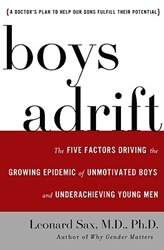
The first two reactions I had to the book were that 1) we need to fix our schools (the sooner, the better) and 2) we need to teach boys to fail well. Here are my final two thoughts:
3. Value Creativity over Consumption
In Dr. Sax’s words, many boys become adults who live as parasites on the people in their lives – mostly parents or spouses. Pamela Haag, in her excellent book Marriage Confidential, makes the same observation – she names parasitic marriages “Tom Sawyer marriages” in which the woman both makes the home and wins the bread while the man contributes little or nothing to the family. A guy still living with his parents is obviously even more likely to be parasitic.
 We must teach boys to value creating over consuming.

Whether it’s art of some kind, more traditionally-male creative outlets like woodworking or working on cars, even programming or blogging. What really matters is that boys learn that to be an adult is to make significant contributions to the larger world, rather that expecting that world to support and sustain us.
Not coincidentally, this is the classic Christian journey from self-centered living to selfless giving in imitation of Christ.
4. Figure out what modern manhood is and ritualize it.
Sax wisely observes that
When adults choose largely to neglect the critical task of sexually enculturing the young, they are left essentially on their own—perhaps with some help from Hollywood and Madison Avenue—to discover the social meaning of their sexuality.
 Our whole culture has radically changed in the last fifty years. Everything – including what it means to be a man – is in flux. But it seems that the only to solutions being discussed are deconstructing gender roles altogether or returning to a utopian 1950s Leave It to Beaver ideal (that never actually existed). No one seems to be advocating a serious third way.
In the meantime, a few generations of boys and girls are growing up without any clear real-world messages about what it means to be a Man or a Woman. No one is teaching kids to take their bodies – and all an embodied life entails – seriously as an integral part of who they are. When it comes to what it means to be a man (read: an adult male), Sax notes:
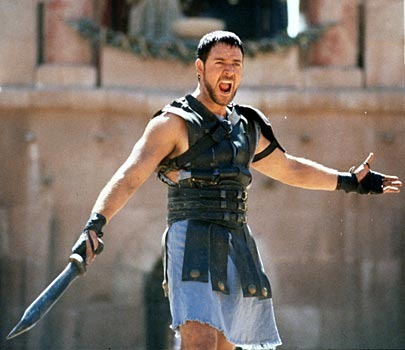
We still have masculine heroes in our movies—think of Braveheart and Gladiator—but scriptwriters seem unable to write a believable story about a boy becoming a heroic man set in our era.
The cliché “Nature abhors a vacuum” is true in this case. If the kids aren’t learning how to be adults from us, they’ll learn it somewhere.
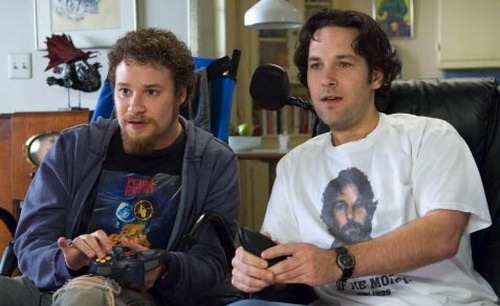 We underestimate the influence popular culture has on our minds and souls. I’d argue that we do have heroic man stories in our movies, but now they’re Judd Apatow comedies about guys who (finally) grow up and take responsibility for their lives: the macho sexism and selfishness of the Anchorman and his team is mercilessly ridiculed. The 40-Year-Old Virgin finally sells his toys and gets married. After Seth Rogan gets his girlfriend Knocked Up, he realizes that a man has responsibilities boys don’t. Two losers stuck in a dead-end job finally grow up when they become Role Models for two younger guys.
Judd Apatow’s manchildren are a long way from Braveheart and Gladiator. And I’m the last person to advocate that we return to Medieval or Roman definitions of manhood (nevermind how historically inaccurate those depictions of manhood actually are!).
 But we can do something. I’d love to be a part of a community that seriously tried to figure out what it means to be an adult male (and an adult female). For that community to then take seriously the task of teaching their children (not in a classroom, but in lived, experiential realities) what it means to be a Man/Woman. For that community to create fun, creative and engaging coming-of-age ceremonies.
We need clear pictures of adulthood, and clear rituals that mark the end of childhood.
What are those roles? I’m not sure. I do know there’d be a lot of overlap. To get started, we could do a lot worse than Dr. Sax’s parting advice:
We must, for the sake of our children, rebel against [our] culture. We must create a subversive counterculture that promotes such unfamiliar notions as:
1. Real men love to read.
2. What really counts is not how you look but who you are.
3. Achievement in the real world is more important than achievement in the virtual world.

2 replies on “Book: Boys Adrift by Leonard Sax (Part IV)”
Great final post. I get excited about being in a community that is figuring out what a real adult man and woman look like and then creating experiences to help them develop into that. LOVE IT. Jake and I have only briefly starting thinking about that for our own kids, but not too much yet. So far we know that real men and women will be potty-trained, sleeping in a big kid bed and won’t have a paci. Those are our family’s marks of a “big kid”. Hahaha, so I guess we’re well on our way, right?
On another note, while I LOVE to read and value it and all, I dont’ know about “Real men love to read.” I mean, I would hope so, but I know real men that don’t like to read at all, but like other medium to get information (i.e. podcasts, ted talks, discussions with real live people, etc.). How do you feel about that? I mean, I know you are a firm advocate of leaders need to always be reading, but not all men are “leaders”….
Great points @google-d4ac4b24515a2a0d5cea1d415780322b:disqus . I’ll second the idea that it might not be the case that “real men/women read”. It standardizes a value and then shames those which aren’t built like the framer of the value.
And that same principle might be at work if we, as a monolitic or series of communities have a singular definition of “manhood” and “womenhood” that each male and female have to adhere to or face explicit and/or implicit shame.
And so I’d like to offer up the addendum that we talk about a range of masculinites and a range of feminities that are healthy.
Thoughts?