
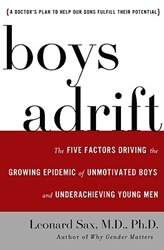
3. Medications for ADHD
No big surprise that this showed up on the list. The pushback on doctors’ carefree try-it-and-see approach to prescribing Adderall, Ritalin and other ADD/ADHD medications is already gaining momentum. But Sax offers shocking evidence from new studies that these kinds of medicine improve focus in persons whether or not they have ADHD. That means if Johnny isn’t paying attention at school and the doctor prescribes Adderall “just to see if it works”, it’ll work. Johnny will be more attentive whether he actually has ADHD or not.
So what’s the big deal? Well, it turns out there’s a good chance most of these medicines seriously damage an area of the brain called the nucleus accumbens. It’s the part of the brain that translates our motivation into action.
In other words, taking ADHD meds – especially if you don’t have ADHD – could seriously alter a boy’s personality, making him lazy and irritable.
 Sax offers several excellent cautions for those who receive an ADHD diagnosis, including a longer checklist for parents to determine if a teacher or family practitioner’s ADHD diagnosis warrants the opinion of a trained specialist (or if you should ignore it).
Sax points out that usually, the school is the problem, not the boy. We’ve designed schools that aren’t developmentally appropriate for boys. And he’s adamant that
We should not medicate boys so they fit the school; we should change the school to fit the boy.
4. Endocrine Disruptors
 Probably the most speculative of Sax’s factors (though that could also be because I’m not a scientist), he identifies a group of chemicals used in most plastics manufacturing. Known as BPAs, these chemicals are xeno-estrogens, meaning they simulate the effects of estrogen on the body.
BPAs might explain why, for instance, the average teen boy today has a sperm count one quarter what his grandfather did at his age.
Sax recommends using mostly glass, and watching for plastics that are clearly marked BPA-free.
5. The Revenge of the Forsaken Gods
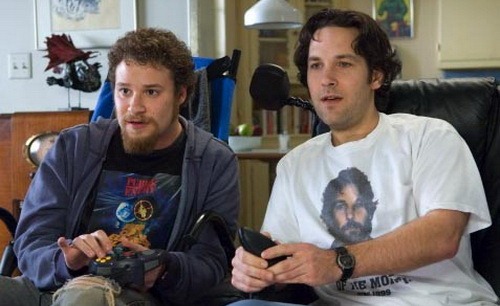 Quoting another scholar, Sax observes that
Manhood is mimesis. To be a man, a boy must see a man.
Transitioning from childhood to adulthood is more than just a biological process. We can be physically mature without being mentally, emotionally, spiritually or socially mature. And throughout human history, the cultures that thrive and survive are those cultures that carefully manage the transition from boy to man.
Healthy cultures not only have communities of men that help boys transition into adulthood, they ritualize it with coming-of-age rituals.
 Today, males of every age are mostly segregated from males of other ages (this is true for females, too, but that’s all in Dr. Sax’s next book). We’ve lost the intangible life-lessons that come from unstructured time spent around men older and younger than us.
Sax is quick to caution us against a blind desire to return to the “Good Ole Days when men were men.” Such days exist only in hindsight, and the world has changed too much in any case. We must move forward very carefully, as Sax observes:
Not all traditional gender roles deserve to be condemned as gender stereotypes. There are life-affirming gender roles and there are gender stereotypes that are harmful and destructive…
Sax argues that ignoring our gendered experience altogether does far more harm than good for boys and young men:
“Deconstructing” all images of the ideal husband and father is not likely to result in a father who insists on his wife sharing equally in all sacrifices. The result is far more likely to be a selfish young man who doesn’t feel any strong obligation to the children he has fathered.
Gender is a tricky, complex topic, and it needs to be approached as such. But it still must be approached. Because when boys are surrounded by men who teach them what it means to be an adult, a man, they grow up well. When boys grow up without men, they tend to create their own groups – anything from gangs to LAN parties, I suppose. Anything but men.


5 replies on “Book: Boys Adrift by Leonard Sax (Part II)”
thanks for this second part! I’ve been eagerly awaiting it (or i guess i could have just read it by now) :).
Reason #3. It has been my understanding that only psychiatrists (not family doctors) can do a diagnosis of ADHD. For my brother, he had to undergo hours of testing in lots of areas (by multiple people, in multiple settings) before the diagnosis was made. That was 20 years ago though. Can the diagnosis and medicine now be prescribed by a family physician?
Reason #4. Interesting! I’ve read that many of the plastic containers that have the recycling numbers 3 or 7 have BPA in them, as well as aluminum cans.
Reason #5. This makes a ton of sense. We talked about this a lot in some of my formation classes. So important about the rituals.
What kind of gender roles does he think are good to keep? You’re right, this is a delicate territory. I think that the deconstructing of women’s role as mother and wife sometimes creates this same allowance to be selfish and can create less expectation to take the role of mothering seriously, so I can imagine that it would do the same for men.
1. ADHD meds – you’re right about diagnosis. Unfortunately (apparently – I don’t have real-world experience with this), a teacher who has a problem student can tell a parent “I think your kid has ADHD.” Parent takes kid to family physician, who CAN just prescribe a med under the “Let’s try it and see if it helps” logic. The meds WILL help in the short-term, so parent, teacher and doctor assume the teacher’s pseudo-diagnosis (which isn’t about the kid at all, but about what’s best for the teacher/bad classroom system) is accurate.
2. Gender roles – Sax doesn’t actually go into this much at all. No one does, that I’ve found (excepting Driscoll and all that garbage). In his book on girls (which came out after this one), Sax makes the same observations about a lack of multi-generational female community.
As I wrote to @hundiejo:disqus below, I think it would be wonderful for a community to come together and figure out what some healthy images of Male and Female could be.
Thanks for the second part of your review, @JRForasteros:disqus as well. While I have significant disagreements with Sax so far, it is good to start the conversation. I’ll try to keep this comment short, the previous three iterations of it were just too long.
I buy some of these claims, like the over-medicating of our children (not just boys). Others I’m pretty suspicious of, such as the claims about BPAs.
His last claim is… half right. He’s right about the modeling, but he’s wrong (at least in terms of totality) in terms of cause. I see it more of the world pre-supposed in the modeling doesn’t exit anymore. I think you alluded to this in conversations had around Marky-D’s “Boys who can Shave” bit. You did allude to this in your post “If 50 is the New 30…”.
I’d take it further. Not only is the script spread out over additional decades, but the life-pathways that were given in the previous generation(s) just don’t exist. A cursory read through of economic and sociological blogs should be sufficient to demonstrate the painful reality of this point.
I want to stress this because of the people I know who are stuck in the so-called extended adolescence have those quality role models who modeled well strong male roles. These boys are adrift because there is nothing left to which they can moor.
You’re hitting on something that’s weighing heavily on my mind these days. And, for what it’s worth, I think Sax would be in agreement.
The reality is, our culture has changed dramatically in the last 50 years. What counts as masculine or feminine has changed. Or maybe it’s better to say that what used to be manly/womanly just doesn’t work in today’s culture. (this is what Sax would agree with).
What I wonder is whether a community can create ideals of masculine and feminine, and then work to embody these ideals. The creative act would have to be provocative, innovative and informed. And, IMO, there could be tons of overlap (BOTH ideals should be selfless, for instance).
But this would give communities of males and communities of females stuff to pass on, stuff to celebrate together. It would need to be balanced by mixed-gendered activities and celebrations too, but I think there’s some real merit for both boys and girls in reimagining these roles and rituals.
It’s fraught with pitfalls and difficulty, but as Sax observes, the alternative hasn’t actually worked out very well either.
First some agreement, then some pushback.
Indeed, and I think a necessary component would be allowing these communities to craft “ideals” that are (and are understood to be) particular to the community. Much of this discourse is stuck on the need to have every role be a universal.
To offer some I’m not so sure the alternative(s) have been given time to work themselves out. What new is not messy, especially when contested by a broken, entrench system of power imbalance? 😉
@Meredith_Imler:twitter and I think about these issues each day with each toy we buy and each activity we do with Reed. There’s no easy answer.