
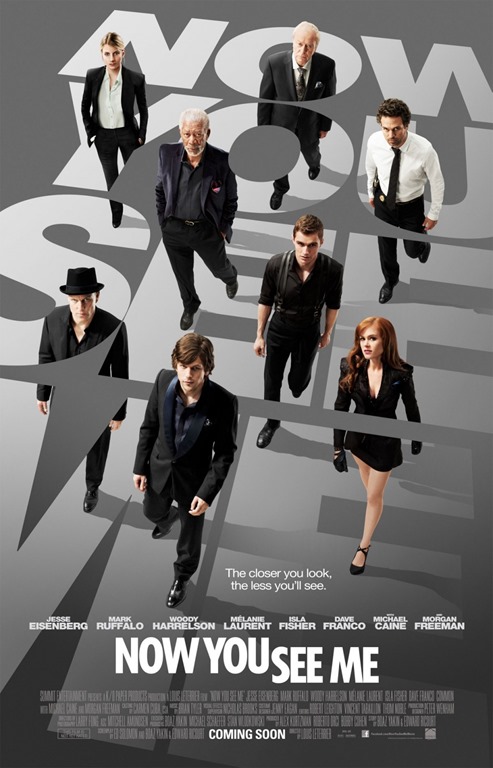
 Now You See Me is the star-studded new film about a team of magicians who use their skills to perform Robin Hood-like capers. The Four Horsemen (Jesse Eisenberg, Woody Harrelson, Isla Fisher and Dave Franco) – as they call themselves – are assaulted on all fronts: Dylan Rhodes (Mark Ruffalo) tries to arrest them while Thaddeus Bradley (Morgan Freeman) seeks to unmask them for profit.
As every trailer for the film promises, Now You See Me pulls one over on the audience. As any good movie about magic should. But Now You See Me‘s denouement doesn’t feel like the payoff you’ve been waiting for.
Now You See Me insults its audience, rather than delighting them.
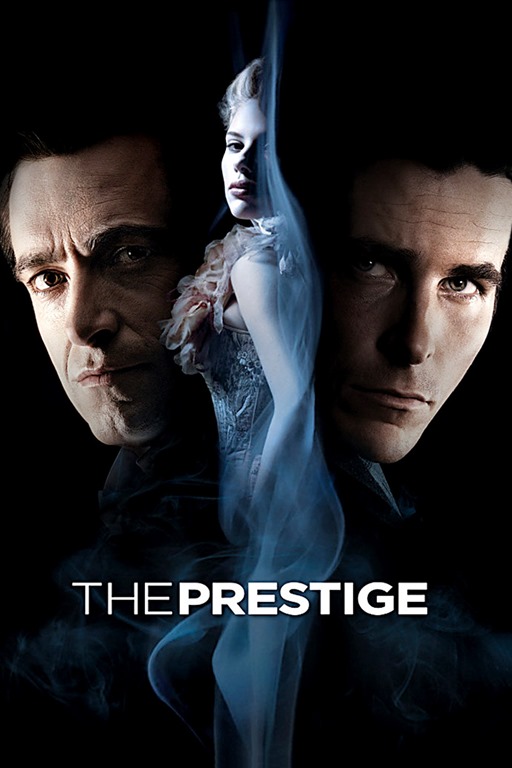 Compare Now You See Me to another shockingly similar film about magic, The Prestige. Though at first blush the films seem dramatically different, they’re the same basic story and the same kind of storytelling. But while The Prestige uses its storytelling magic to thrill, Now You See Me seems only to want to prove that it’s smarter than you are.
Both films center on a long-standing magicians’ dual – Bradley vs. Rhodes and Angier vs. Borden. Both films feature master magicians who live dramatic lies to preserve their master illusion – Rhodes lives under a false name as an FBI agent and Borden is twins who live as a single person.
Both films are magic tricks themselves, explicitly inviting the viewers to try as hard as they want to figure it out.
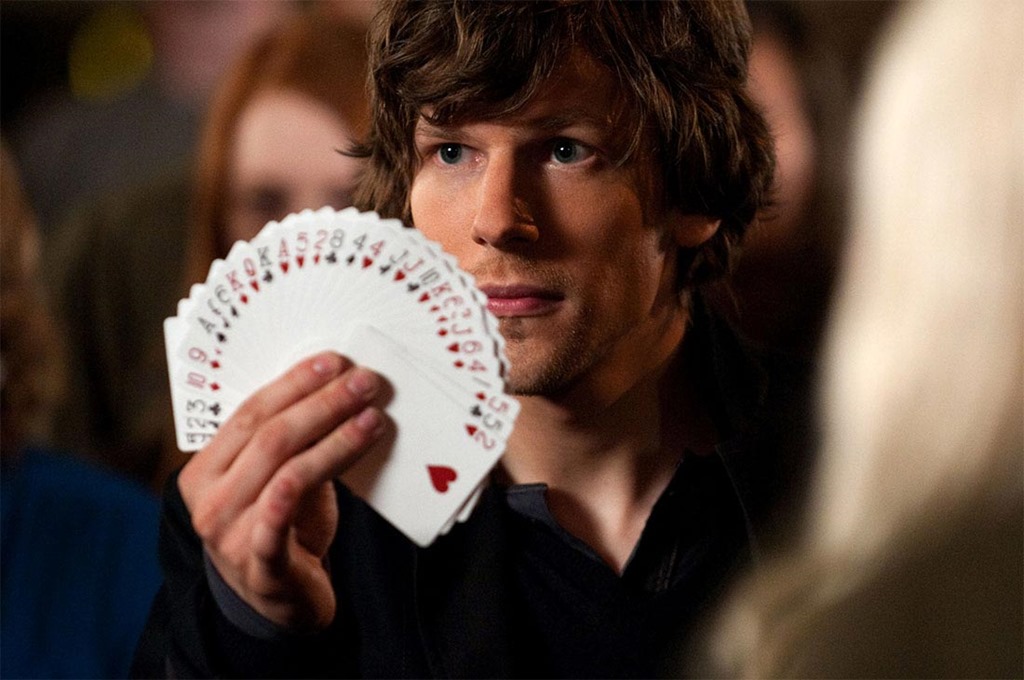
Now You See Me‘s Daniel Atlas (Jesse Eisenberg) repeatedly invites viewers to look as close as we want because,
The closer you’re looking, the easier you are to fool.
The Prestige‘s Cutter (Michael Cain) explains the three stages in a magic act (which parallel the three acts of the film). In the midst, he claims,
Now you’re looking for the secret. But you won’t find it because of course, you’re not really looking. You don’t really want to work it out. You want to be fooled.

The Prestige presents magic film as an unwritten contract between the magician filmmaker and the audience. The magician is an entertainer who respects their audience as people who came to have fun. Of course we don’t believe in magic (or, we don’t think we’re watching a documentary). But that’s not why we came. We want to suspend our disbelief. We want to be fooled. Entertained.
Now You See Me is a much more cynical film. Their first rule of magic is “Always be the smartest guy in the room.” From the beginning, the film establishes an adversarial relationship between we the audience and the magicians. We’re never certain who we should identify with, and all the while, the film lets us know that confusion is part of the magic trick.
The film condescendingly invites us to try to figure it out, all the while promising we’re too dumb to get it.
In the end, we end up identifying with Bradley (Freeman) and Tressler (Cain), the two men who were most fooled. They’re also the film’s two clear villains. In general, in storytelling, forcing your audience to identify with the villains of the film just doesn’t work. Neither does condescending to your audience.
It’s no wonder Now You See Me‘s big reveal left me feeling apathetic. Unlike The Prestige, this film didn’t aim to entertain me. Its goal was to outsmart me. Rather than inviting me in as a partner in the illusion, Now You See Me cast me as an adversary.
Both The Prestige and Now You See Me capture the magic of filmmaking. But while one invites us to partner with it to enjoy the spectacle, the other dares us to try to outsmart it. No matter how successful the film winds up, I won’t be rooting for it. I’ll either feel smug (if I figure it out) or spiteful (if it tricks me). Neither is how a good magician (or storyteller) wants to leave an audience.

One reply on “Now You See Me”
Actually, I liked it. Maybe because I wasn’t expecting much out of it; I just wanted to have some fun. The ending wasn’t so much a surprise as just a standard reveal. I mean, if you’re a story person at all (if you watch movies and read books), you gotta figure the connection from the moment that story is told. It was just a matter of which one of the characters it would be and the specific nature of their relationship. That was fine by me, and I wasn’t really trying to figure that out as it was going along. I was just kind of enjoying the show and waiting to see who it would be. And I wanted to know if they’d get away with it all or not.
I didn’t identify at all with Cain, and was merely interested in Freeman’s character, wanting to see where he would end up in all of it when it was over. I identified more with Ruffalo and his frustration with always seeming to be behind their game. And I liked the magicians, despite their arrogance, more so toward the end, when you find out more about their involvement through their conversation when leaving the original apartment. Some of that may have been simply because I like those actors. For me it was basically a little bit of fun: a little actiony, a little spectacle, a little whodunnit. Not a bad way to spend a couple hours on Friday afternoon. 🙂
Now that I know who done it, though, I’m having a little mental fun working back over some of that person’s machinations in my head. I’ll watch it again on dvd when it comes out and it’ll be fun for me to see it with an eye out for how that person manipulated the whole thing. I’ll have to check out The Prestige too.