
You lack imagination. – Doctor Stephen Strange
DOCTOR STRANGE represents the fourteenth Marvel Studios film and the third in Phase Three. It’s wonderful – as fast-paced and funny as any Marvel film to date (with the possible exception of Guardians of the Galaxy). The major drawbacks are that it is yet another origin story (which was wise – none of the three people with whom I saw the film knew anything about Doctor Strange) and yet another cardboard villain (they are seriously not giving us much hope for Thanos).
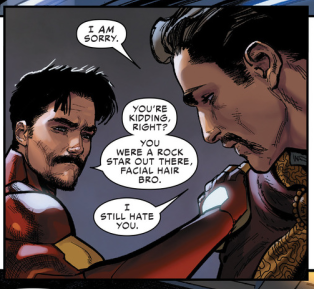
While it’s getting harder and harder for stand-alone Marvel films to compete with the team-ups, it’s safe to say that if you like the other Marvel films, you’re going to love Doctor Strange. It’s visually stunning and so much fun, you won’t even notice it’s a complete retread of Iron Man (arrogant, wise-cracking jerk gets hurt, saved by a wise, old stranger and learns to use his powers for good. With a goatee.). Or if you do notice.
Thematically is where Doctor Strange really shines. Read more (including lots of spoilers) after the jump.
Dr. Stephen Strange is a brilliant but arrogant neurosurgeon who is too busy making a name for himself to care about the little people – specifically the individual lives he can save by working in an ER. In an early scene, we literally watch him refuse case after case (including one James Rhodes, injured in CIVIL WAR) because it doesn’t benefit him.
Beneath Stephen’s arrogance is a quest for immortality. He wants to leave his name on something. And beneath his quest for immortality is a fear of Death.
The inevitability of Death, embodied in the intractable march of Time, overshadows Doctor Strange.
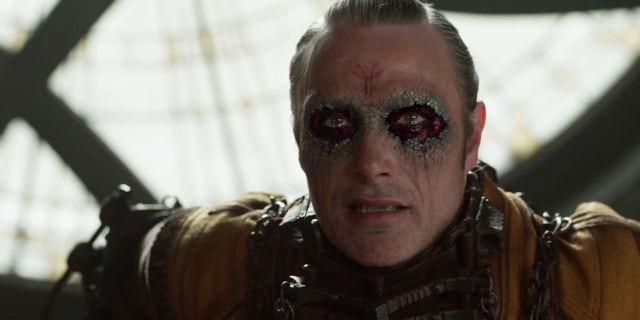 Kaecilius seeks to become immortal, and so makes a deal with Dormammu – essentially Marvel’s version of Satan. Dormammu inhabits the Dark Universe and seeks to subsume the whole multiverse into his person. Kaecilius repeatedly fantasizes about becoming one with the One.
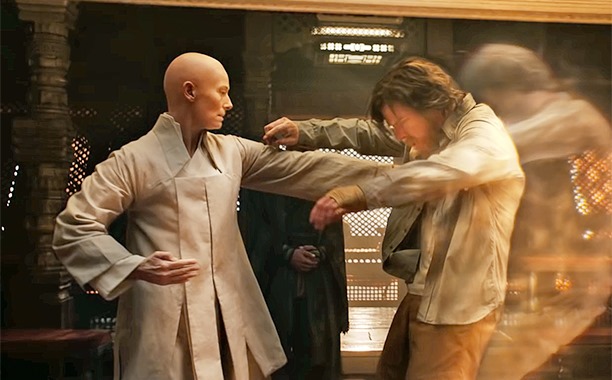
Strange’s teacher, the Ancient One*, prolongs her life by drawing power from Dormammu. Though she repeatedly chides Strange for fearing failure rather than loving life, we learn she too has compromised her principles for the sake of immortality.
 Death is the ultimate enemy for a materialist like the Stephen Strange we meet at the beginning of the film. Strange does not believe in a spirit world of any kind. He insists humanity is only matter, that there is no greater world beyond what we can experience with our senses. This philosophy is called Materialism, and in a materialistic universe, Death is the ultimate enemy. Where there is no Spirit, no resurrection, Death is the End. Time is the ultimate enemy.
In its critique of Materialism, Doctor Strange suggests that only by embracing death can life truly flourish.
 Just before she dies, the Ancient One observes this explicitly. As she reflects on the necessity of embracing Death, she warns Strange that his fellow pupil, Mordo (who, spoiler alert, becomes Baron Mordo), is too rigid. When Mordo learns the Ancient One has broken her own rules, he cannot abide her perceived betrayal. Because he cannot embrace the death of his beliefs he embarks on a quest to rid the world of sorcerers (if that post-credits scene is any sort of teaser).
But it’s not until Doctor Strange is lying face-down on the streets of Hong Kong, having witnessed the horrifying loss of life Kaecilius has inflicted on the city, that he understands what it means to love life enough to fight.
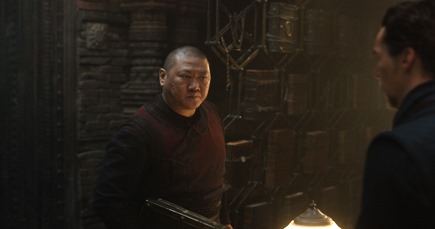 His first showdown with Kaecilius results in Strange killing one of Kaecilius’ disciples. Horrified at having broken his Hippocratic Oath, he steadfastly refuses to kill. When Mordo pushes him on this, Strange insists that Mordo “lacks imagination.”
On the streets of Hong Kong, Strange demonstrates what he means. He flies into the Dark Universe to confront Dormammu. He uses the Eye of Agamotto (which we learn is the Time infinity stone) to create a temporal loop, essentially resetting itself every time Dormammu kills him.
Strange’s temporal loop illustrates what theologians call the Christus Victor (“Christ the Victor”) model of atonement.

Atonement asks what Jesus accomplished on the Cross, and the Christus Victor model states that on the Cross, Jesus defeated the forces of Evil by dying.
How does one win by dying? Strange shows us how. He limits Dormammu – the demon cannot escape the loop, cannot attack the people of Earth. Strange then directs all of Dormammu’s rage and violence on himself. Dormammu can kill Strange as many times as he wants but is powerless to do anything else. Eventually, the demon’s rage is exhausted and turns to desperation, at which point he is under the Doctor’s power.
“You cannot win.” – Dormammu
“No. But I can lose. Again and again.” – Doctor Strange
This is how theologians talk about the Cross. On the Cross, Jesus swallowed up the power of Evil, taking upon himself such that it exhausts itself upon him. Humanity is thereby freed – this is what we mean when we say that Jesus paid our ransom with his own blood. He bought us out of Death by his own suffering.
Strange’s journey into the Dark Universe is essentially Christ’s harrowing of Hell.
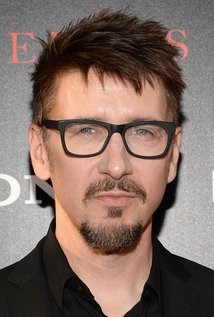 Such powerful theological themes should be no surprise to anyone who’s a fan of the film’s director, Scott Derrickson. Derrickson is an openly Christian filmmaker whose faith is often overlooked because he chooses to make primarily horror films.
In the end, the once selfish Strange gives his own life up again and again. He defeats Evil without striking a single killing blow, but instead giving up his own life to turn evil back on itself.
BOTTOM LINE: The thematic underpinnings of DOCTOR STRANGE save it from being a fun but forgettable retread of the Marvel formula.
YOUR TURN: What did you think of DOCTOR STRANGE?
* Tilda Swenton was incredibly good in this role, but I am still sad the character wasn’t Asian. That said, if the Ancient One had been Asian (like in the comics), then the “White Westerner goes to the mystical East to learn magic” trope would’ve been even more obvious. Given Doctor Strange’s awkwardly dated origin story, maybe the studio did the best they could.

6 replies on “The Passion of Doctor Strange”
I’m glad I’m not the only one who was seeing some theological connections. Kaecilius’s speech while he was tied up in the Sanctum Sanctorum was eerily similar to something I said in a sermon recently, enough so that I was squirming a little. But I completely missed the Christ metaphor in the final confrontation. Shame on me. 😉
When he said, “I can lose. Again and again.” I got chills and had the biggest smile on my face. I wanted to stand up and cheer!
Oh man. So, so good. I waited until after seeing it before reading your review (though I was sorely tempted!), and I was totally on the same page with the Christus Victor stuff. However, I had a slightly different take on the role of “The Ancient One.”
Suppose the Ancient One occupies the role of Christ figure. Then we’ve got three disciples on a journey: Mordo, Kaecilius, and Strange. What are their paths of discipleship? Mordo wants righteousness, rigidly defined by good and evil. Kaecilius wants eternal life (and did you catch the nod to A.N. Whitehead: “the many become one and are increased by one”?). Strange, however, doesn’t fear death so much as failure: he doesn’t want to lose.
Where do these quests lead them? Mordo cannot follow a Christ who leads him into the dark. His words to Strange about trusting the teacher prove false: he only trusts the Ancient One so long as she conforms to his view of good and evil. When she deviates from that, it turns out that his true teacher is not the Ancient One, but his own moral compass. He cannot trust.
Kaecilius seeks eternity and, like all madmen before him, commits evil “for the greater good.” He’s a Process Philosopher, and evil is just another tool one uses on the quest for the Good, the True, and the Beautiful. Every act he performs is utilitarian and completely rational: if perpetuity is goal of life, then his every act is correct. To him, the Ancient One is little more than an obstacle to be overcome; his true goal is not the wisdom she offered him, but his own immortality.
Strange fears losing. He cannot fail, whether it’s his Guess the Song game, his selection of surgical procedures, or surrendering to the teachings of the Ancient One. His path is every bit as doomed as Mordo’s and Kaecilius’s, except that in the end, he followed the Ancient One into death and loss and failure. She taught him magic, sure, but more importantly, she taught him how to die. Death is the ultimate failure, and Strange accepts it.
In each case, the Ancient One leads her disciples on the path toward death, darkness, loss, oblivion, restraint, failure. The only real difference between Strange and the other two is that Strange follows her there. In the end, it’s he that trusts his teacher and follows where she goes.
This is fantastic. Really fun way to read the film!
Hey bro, enjoyed reading your review. The Christus Victor observation never even crossed my mind, great way to think about the film. Makes me like it even more. The movie was definitely cookie cutter Marvel, but the more DC continues to disappoint, the more I appreciate Marvel’s predictability.
Also, I saw the film here in East Asia. You know your the only native English speaker in the theatre when you repeatedly laugh out loud and realize no one else is laughing with you 🙂
[…] Doctor Strange at Rotten Tomatoes Doctor Strange: Misleading Spirituality at Reel World Theology The Passion of Doctor Strange at Norville Rogers The Complex Faith of Doctor Strange Director Scott Derrickson at Relevant Doctor […]