

Who’s that there stumbling around in the dark?
The question, from a slaver’s lips, opens Quinten Tarantion’s newest and most audacious film to date, Django Unchained. The film is shocking and divisive, mostly because of how starkly it portrays the evils of slavery, complete with liberal use of the “n-word” and Samuel L. Jackson’s controversial turn as head house-slave Stephen.
By showcasing the evils of slavery, Tarantino is forcing America to face our ugly past, to ask if we know who we really are.
Back in 2007, when discussing his previous film Inglorious Basterds, Tarantino said,
I want to do movies that deal with America’s horrible past with slavery and stuff but do them like spaghetti westerns, not like big issue movies. I want to do them like they’re genre films, but they deal with everything that America has never dealt with because it’s ashamed of it, and other countries don’t really deal with because they don’t feel they have the right to.

As films go, Django is a well-constructed, straightforward western, with no real surprises. Django’s Hero’s Journey is clear and enjoyable. The dialogue is sharp, hilarious and fast-paced. It’s Django‘s simplicity that allows Tarantino’s larger point to shine through so clearly.
From the beginning, Django Unchained is clearly not historical. Tarantino is giving us a revisionist history lesson.
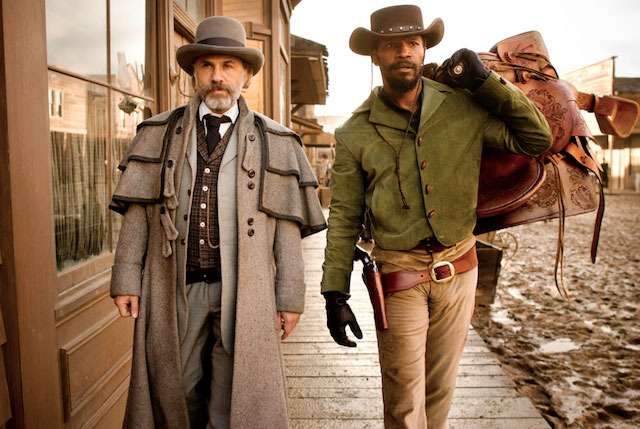
The Mandingo fighting is probably exaggerated. Clearly no former slaves in an Antebellum South could’ve been bounty hunters. But Tarantino knows this. That’s why he heaps on anachronisms: the theme song “100 Black Coffins” by rapper Rick Ross. Calling the setting of the majority of the film Candieland, calling to mind one of America’s most popular children’s board games that wasn’t invented until 1945.
Tarantino wants us to look back at a world that seems fantastic. To see how Calvin Candie (an excellent DiCaprio) treats his slaves, how Stephen the head house-slave perpetuates his own captivity is nearly unbelievable. Because as unreal as it all seems, the reality is much, much worse than anything Tarantino could put on a screen.
Tarantino is telling America that it’s time to acknowledge the sins of our youth.
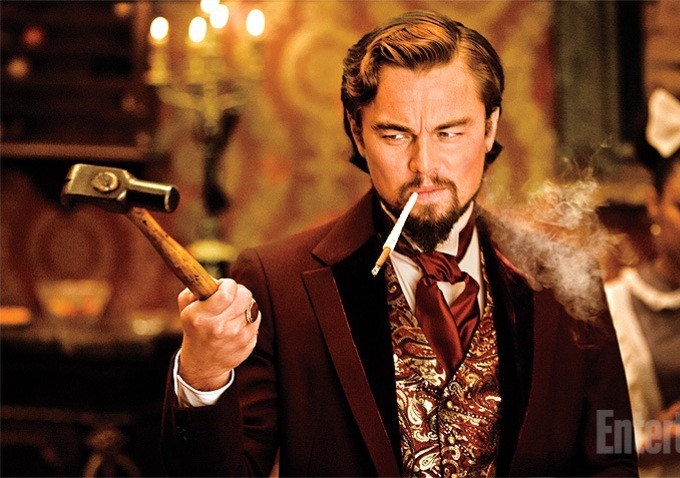
Candie is the consummate juvenile. He affects high European society – insisting that he be called Monsieur Candie even though he can’t speak French. Filling his library with books he hasn’t read. And the ultimate nod is the anachronism of his plantation’s name – Candieland. Candie is a child playing at adulthood.
Tarantino isn’t trying to give us a well-rounded villain we can relate to. Candie is a monster through-and-through. He’s ugly, detestable and pathetic, even as he terrifies. Candie’s character is a strong statement about the pure, unquestionable evil of slavery.
But Candie isn’t someone else. Of the three main characters in the film – Schultz, Django and Candie, Candie is the only white American. In fact, no white American men in the film were “good guys” – at best they were neutral or confused.
We can’t blame anyone else. Our sins are our responsibility, and it’s time to own up to them.
Facing the ugly, violent reality of slavery, even in a fun spaghetti western, isn’t fun. And when it gets uncomfortably violent, when we, like King Schultz, get queasy watching the violence heaped upon the slaves, Tarantino reminds us we can’t turn away:
Candie’s employee [about Schultz]: Your boss looks a little green around the gills.
Django: He just ain’t as used to America as I is.
 This is the American story. We bought into the myth of progress and used it justify our right to own other people. For all our rhetoric, a great and tragic evil in this Land of the Free and Home of the Brave is that there was a time when people could legally own other people.
It’s not pretty. It’s not nice. But it’s real. And unlike the rest of the world, we can’t just turn away from it and pretend it didn’t happen. Slavery is the skeleton in our closet and we need to own up to it.
We can’t move forward as a nation until we know ourselves truly. And until we shine a light on this evil embedded so deeply in our national identity, we will stumble around in the dark, unable to find our way.

6 replies on ““Django Unchained” asks if America has Grown Up”
Saw this movie today.
I cringed. I laughed. I cried. This movie was perfect.
This is actually the first Tarantino movie I’ve watched in its entirety. It was violent and very bloody, but the message was definitely necessary.
Thank you for this review. 🙂
Thanks! If you liked this one, you might try Inglorious Basterds. It’s the only other Tarantino I really enjoy (okay, that and Resivore Dogs)
I am not sure if it created a “healthy” discussion because as you stated above about parts of the dialogue, it was “hilarious”. I walked away not really sure what the point was, was it comedy, making fun? Or was it supposed to be as thought provoking as you say. While I do agree with what you are writing above I certainly didn’t leave the theater feeling that way and almost felt confusion as if the film was contributing to more of the problem. Just my thoughts, I neither loved nor hated the film.
I would say that humor can be an excellent way to incite dialogue. Usually when I’m laughing my defenses are down and I can think more openly about something.
Did you see the film by yourself? I saw it with my wife and two good friends, and we spent quite a while discussing it afterwards. I wonder if that makes any difference?
wait,wait wait- the writer dislikes kill bill and pulp fiction but likes basterds, django and dogs. Are you me from another timeline?
Alternate me -Did you view kill bill as a over long tribute to movies no one else (aside from people like us) has ever heard off?
Well done on the review btw – i’m not american but you got to face up to it. This movie made me winch with some scenes. And no so much the torture – more Jackson’s slippery character (and the copious amounts of genitalia meets bullet action- for any man that’s not nice to imagine)
Once again- nice review! Best of luck in the future